- Home
- /
- Alumni Affairs
- /
- Alumni Update 2
Alumni Update 2
The Craig Newmark Graduate School of Journalism at CUNY was built to adapt and experiment. Since its founding, the school has prepared journalists to navigate change |and meet the evolving information needs of the public. As the industry has transformed—from the rise of digital platforms to the emergence of generative AI—Newmark alumni have helped shape what journalism becomes next.
When the school opened in 2006, the media landscape was already shifting. The internet was transforming how news was produced and distributed, and the decades that followed brought rapid innovation across platforms, audiences, and technology.
At a time when many journalism programs are contracting, Newmark is growing: expanding recruitment and enrollment, and graduating reporters, editors, and entrepreneurs who are attuned to the evolving information needs of our society. This moment presents an opportunity to reinvent journalism to be more relevant, accessible, and responsive to the public.
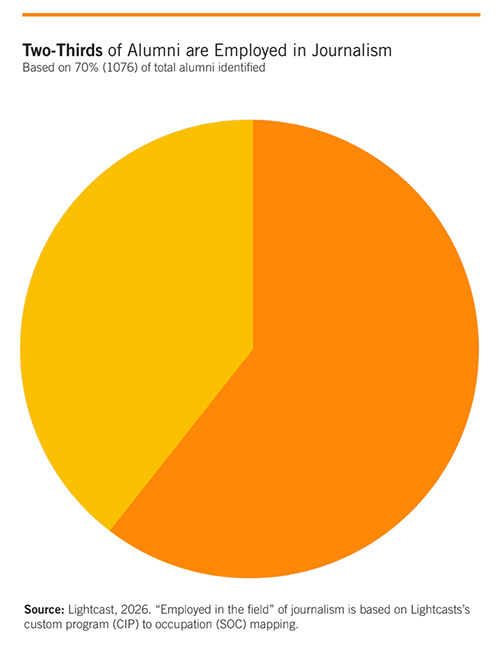
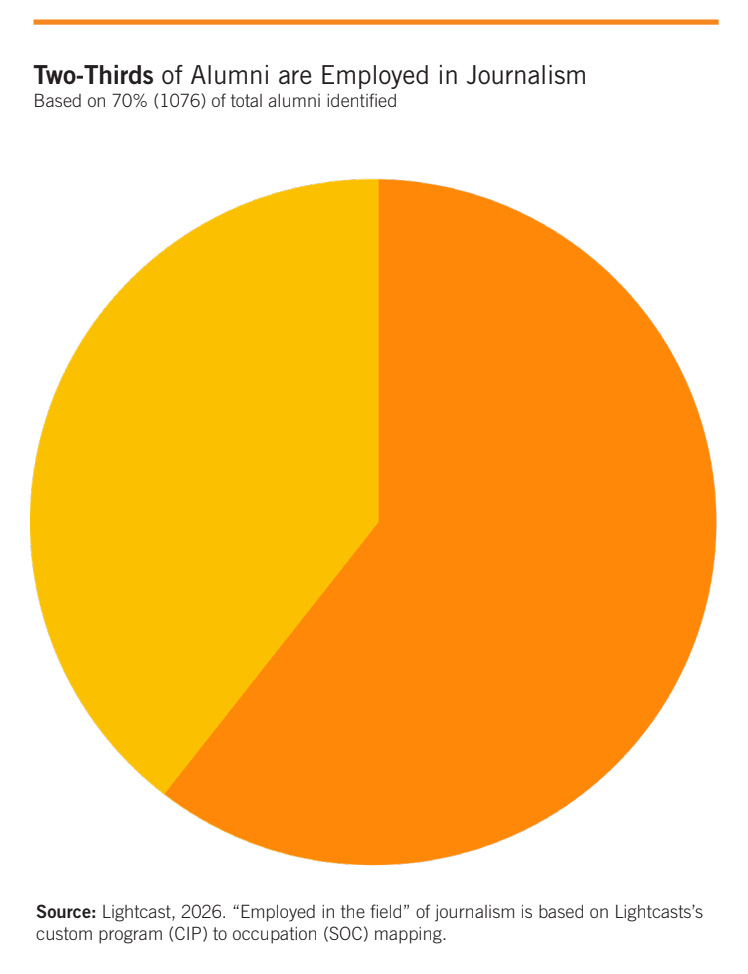
As we mark our 20th anniversary, we do so with confidence in our alumni and current students who are reimagining the field. That confidence is borne out in outcomes: two-thirds of our graduates are employed in journalism, a rate that reflects both the caliber of our training and the resilience of our graduates in navigating a rapidly evolving industry.


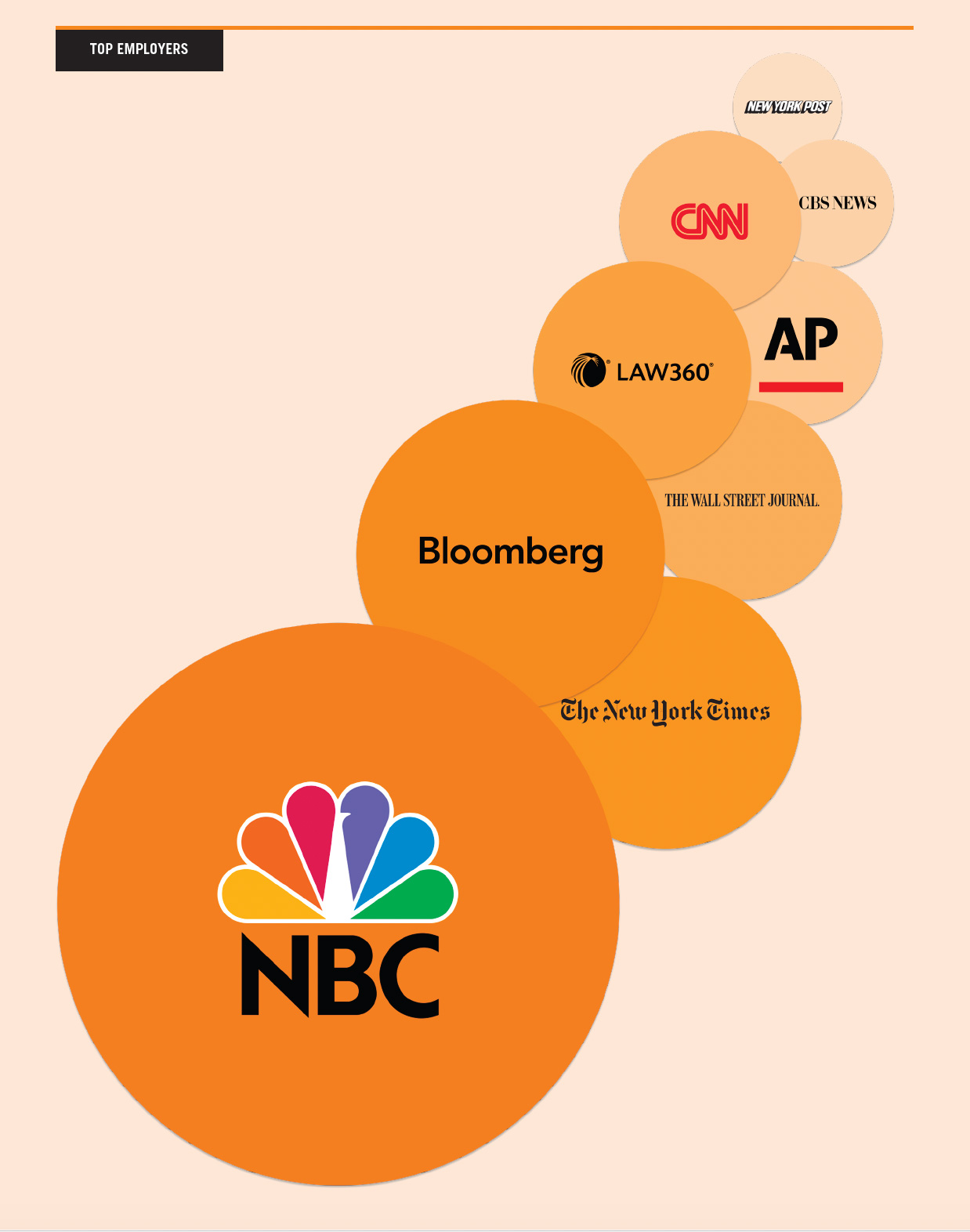
The breadth of Newmark alumni reach is visible in the organizations where our graduates have built their careers. From established broadcast networks and legacy newsrooms to digital innovators and specialized legal and financial outlets, our alumni appear across the full spectrum of modern journalism.
The top occupations tell a similar story of range. The largest cohort works as news analysts, reporters, and journalists, doing the core work of the craft. A significant and growing share have moved into editorial leadership as editors, into creative and production roles as producers and directors, into organizational leadership as chief executives, and into the broader storytelling economy as writers and authors.


Simone Sebastian (‘10) directed all editorial coverage for Capital B, a nonprofit news organization that centers Black voices.
Max Rivera (‘24) reported for Bloomberg on how college programs are skirting new $20.5 million roster caps, exposing the workarounds schools are using to keep paying athletes.
Gary Lavariere (Exec ’25) advanced from Chief Revenue Officer to Publisher at The Berkshire Eagle, stepping into top leadership to help guide the future of a local news organization.
Marc Gendron (Exec ’23) rose to Publisher at Le Soleil, taking on a leading role at one of Quebec’s major news organizations and shaping its digital growth strategy.
Across all programs and years of graduation, the median estimated salary for Newmark alumni is $114,900, reflecting both career-stage diversity of our alumni body and the strength of our graduates in markets like New York City.
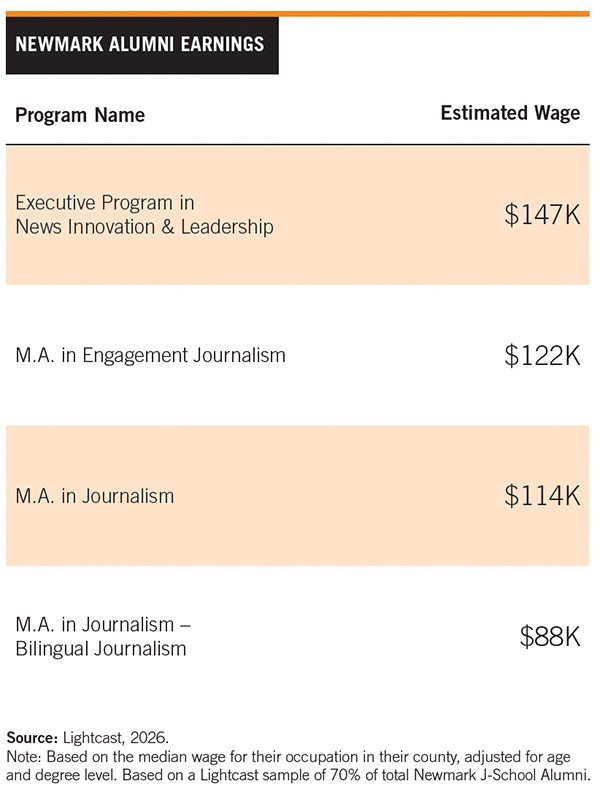
Earnings vary meaningfully by program, reflecting the different career trajectories each track is designed to support. Graduates of the Executive Program in News Innovation and Leadership, built for senior professionals, earn a median wage of $147,000, consistent with their more advanced career stage. Alumni of the M.A. in Engagement Journalism come in at $122,000, a testament to the growing demand for journalists who can bridge community relationships and digital strategy. The core M.A. in Journalism sits at $114,000, while M.A. in Journalism (Bilingual Journalism) graduates earn a median of $88,000, a figure that reflects both the early-career status of many in this cohort at the program’s 10-year anniversary in 2026, and the wage inequities that continue to affect in-language and community-focused journalism.

Walter Smith Randolph (‘10) was the first reporter anywhere to cover the water crisis in Flint, Michigan, breaking the story before it reached national attention.
Netsanet Negussie’s (‘19) documentaries push the boundaries of nonfiction storytelling, including POWER (Netflix, 2024), which uses an archival collage approach to examine policing, power, and systemic injustice.

Claudia Irizarry Aponte’s (‘18) reporting on New York City’s food delivery workers spurred legal changes that improved conditions for thousands of workers.
Linda Villarosa (‘13), a Newmark professor, has become one of the most compelling voices in the country on the racial inequities in health care faced by Black Americans.

Mike Reicher’s (‘09) Pulitzer-finalist investigation exposed how Washington state spent $1 million per day on construction that failed to protect the environment or tribal treaty rights.
Mary Wilson (‘16) shapes innovative, audience-driven editorial content at LinkedIn, producing high-impact conversations with global leaders like Barack Obama and Serena Williams and helping redefine how professional audiences engage with news and storytelling.
Sophie Rosenbaum (‘13) leads digital innovation at the Associated Press, driving platform partnerships and audience strategies—including scaling a WhatsApp channel to over 1 million followers in under two months—to expand how global news reaches and engages new audiences.


Newmark is New York City’s journalism school. As part of the City University of New York, a public institution grounded in access and opportunity, the school is deeply connected to the city it serves. That responsibility shapes how students are trained, what stories are prioritized, and how impact is defined. Students learn to report in one of the most complex and demanding media markets in the world, covering the city as a primary subject—its neighborhoods, government, schools, housing systems, cultural institutions, and communities.

This training ground requires precision, urgency, and accountability, preparing graduates to cover a wide range of issues in any setting. More than half of Newmark alumni remain in New York, working in newsrooms across all five boroughs and the state. They reflect the diversity of the city itself and bring that perspective into their reporting.
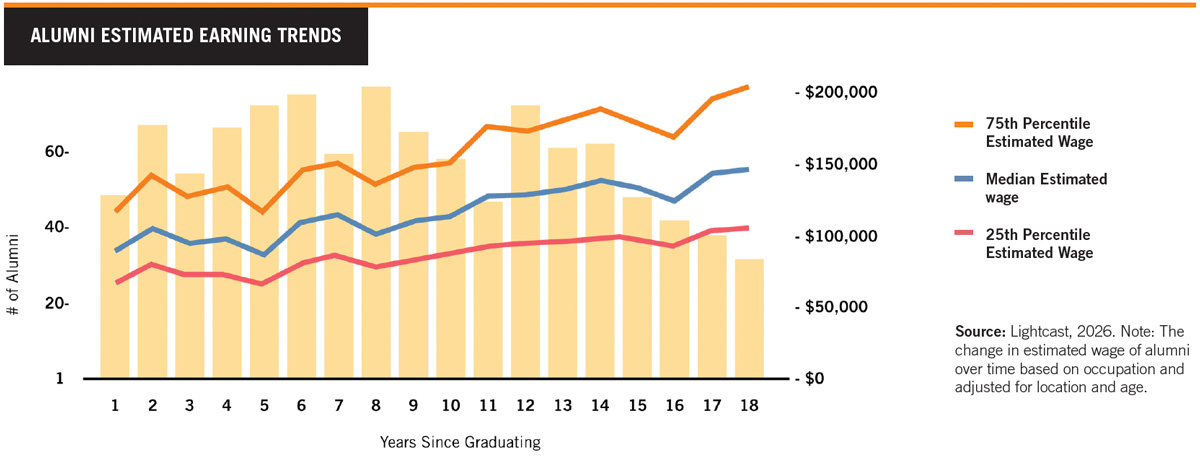
The trajectory of alumni earnings over time reinforces what we see in the field: a Newmark degree compounds in value. Early-career alumni, those in years one through five, are building their bylines and establishing themselves in competitive markets. By years eight through twelve, a clear upward trend emerges at the median, consistent with alumni moving into senior reporting, editing, or leadership roles. At the 75th percentile, the curve steepens:
the journalists and media leaders who have risen to the top of their fields are earning well above $150,000 by the midpoint of their careers, among our highest earning alumni.
This growth curve reflects both the depth of preparation our graduates receive and the ongoing value of a network built over twenty years—one in which alumni hire, mentor, and collaborate with one another.

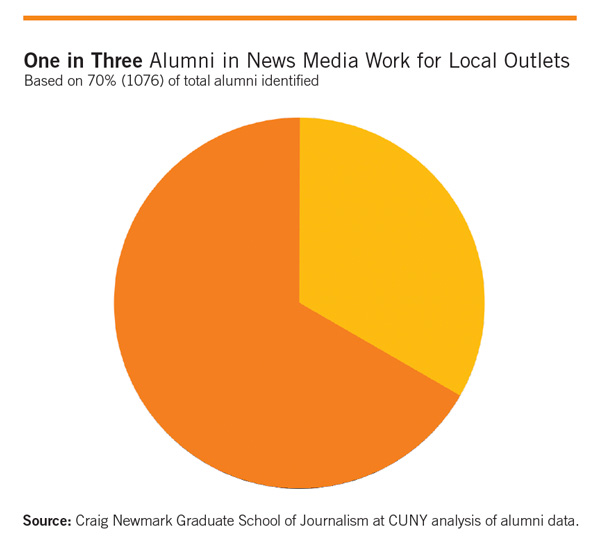
A striking share of our graduates are doing the foundational work of local journalism. One in three Newmark alumni working in news media are employed at local outlets, covering city councils, school boards, neighborhood stories, and the community institutions that national coverage so often misses.
Even as local news deserts spread, a growing movement to rebuild and reimagine local newsrooms is taking hold across the country. Newmark contributes to that effort by training journalists and equipping emerging leaders to launch and sustain community-centered nonprofit news organizations.

Rommel H. Ojeda (‘21) reports for Documented, focused on the issues that most affect Spanish-speaking Latino immigrant communities in New York.
Maritza L. Félix (Exec ‘22) built Conecta Arizona: a WhatsApp-based news service delivering critical, real-time information in Spanish to border communities often left out of traditional coverage.

Ana Valdez Saravia (‘24) launched a Spanish-language newscast at a Kansas TV station, creating a vital news source for alocal community that previously had none in their language.
Joseph Darius Jaafari (‘16) founded and leads LOOKOUT, an Arizona-based outlet which expands LGTBQ+ coverage in local news.

In less than two decades, Newmark alumni have earned some of the highest honors in journalism. Fifteen graduates have been awarded or named finalists for Pulitzer Prizes, reflecting the impact and rigor of their work across beats and formats. Alumni have also earned national and regional Emmy Awards, Peabody Awards, and other major distinctions in journalism and media. Musikilu Mojeed (’10), a renowned investigative reporter based in Nigeria, shared the 2017 Pulitzer Prize for his reporting on the Panama Papers, a global investigation that exposed hidden financial networks and corruption among the world’s elite.
Maggie Freleng (’12) won the 2022 Pulitzer Prize in Audio Reporting for “Suave,” a podcast that follows a man sentenced to life in prison as a juvenile and examines the long-term impact of incarceration and second chances. Paris Brown (Exec ’25) was named Innovator of the Year by the Local Media Association as Publisher of The Baltimore Times, recognizing her leadership in driving transformation in local news. Angela Hill (’12) was part of the Washington Post team awarded the 2024 Pulitzer Prize for “American Icon,” an investigative series examining the rise and impact of the AR-15 in the U.S.
The Craig Newmark Graduate School of Journalism at CUNY was built to adapt and experiment. Since its founding, the school has prepared journalists to navigate change |and meet the evolving information needs of the public. As the industry has transformed—from the rise of digital platforms to the emergence of generative AI—Newmark alumni have helped shape what journalism becomes next.
When the school opened in 2006, the media landscape was already shifting. The internet was transforming how news was produced and distributed, and the decades that followed brought rapid innovation across platforms, audiences, and technology.At a time when many journalism programs are contracting, Newmark is growing: expanding recruitment and enrollment, and graduating reporters, editors, and entrepreneurs who are attuned to the evolving information needs of our society. This moment presents an opportunity to reinvent journalism to be more relevant, accessible, and responsive to the public.
As we mark our 20th anniversary, we do so with confidence in our alumni and current students who are reimagining the field. That confidence is borne out in outcomes: two-thirds of our graduates are employed in journalism, a rate that reflects both the caliber of our training and the resilience of our graduates in navigating a rapidly evolving industry.
Alumni Reach Across Roles & Organizations
The breadth of Newmark alumni reach is visible in the organizations where our graduates have built their careers. From established broadcast networks and legacy newsrooms to digital innovators and specialized legal and financial outlets, our alumni appear across the full spectrum of modern journalism.
The top occupations tell a similar story of range. The largest cohort works as news analysts, reporters, and journalists, doing the core work of the craft. A significant and growing share have moved into editorial leadership as editors, into creative and production roles as producers and directors, into organizational leadership as chief executives, and into the broader storytelling economy as writers and authors.
Simone Sebastian (‘10) directed all editorial coverage for Capital B, a nonprofit news organization that centers Black voices.
Max Rivera (‘24) reported for Bloomberg on how college programs are skirting new $20.5 million roster caps, exposing the workarounds schools are using to keep paying athletes.
Gary Lavariere (Exec ’25) advanced from Chief Revenue Officer to Publisher at The Berkshire Eagle, stepping into top leadership to help guide the future of a local news organization.
Marc Gendron (Exec ’23) rose to Publisher at Le Soleil, taking on a leading role at one of Quebec’s major news organizations and shaping its digital growth strategy.
Across all programs and years of graduation, the median estimated salary for Newmark alumni is $114,900, reflecting both career-stage diversity of our alumni body and the strength of our graduates in markets like New York City.
Earnings vary meaningfully by program, reflecting the different career trajectories each track is designed to support. Graduates of the Executive Program in News Innovation and Leadership, built for senior professionals, earn a median wage of $147,000, consistent with their more advanced career stage. Alumni of the M.A. in Engagement Journalism come in at $122,000, a testament to the growing demand for journalists who can bridge community relationships and digital strategy. The core M.A. in Journalism sits at $114,000, while M.A. in Journalism (Bilingual Journalism) graduates earn a median of $88,000, a figure that reflects both the early-career status of many in this cohort at the program’s 10-year anniversary in 2026, and the wage inequities that continue to affect in-language and community-focused journalism.
Walter Smith Randolph (‘10) was the first reporter anywhere to cover the water crisis in Flint, Michigan, breaking the story before it reached national attention.
Netsanet Negussie’s (‘19) documentaries push the boundaries of nonfiction storytelling, including POWER (Netflix, 2024), which uses an archival collage approach to examine policing, power, and systemic injustice.
Claudia Irizarry Aponte’s (‘18) reporting on New York City’s food delivery workers spurred legal changes that improved conditions for thousands of workers.
Linda Villarosa (‘13), a Newmark professor, has become one of the most compelling voices in the country on the racial inequities in health care faced by Black Americans.
Mike Reicher’s (‘09) Pulitzer-finalist investigation exposed how Washington state spent $1 million per day on construction that failed to protect the environment or tribal treaty rights.
Mary Wilson (‘16) shapes innovative, audience-driven editorial content at LinkedIn, producing high-impact conversations with global leaders like Barack Obama and Serena Williams and helping redefine how professional audiences engage with news and storytelling.
Sophie Rosenbaum (‘13) leads digital innovation at the Associated Press, driving platform partnerships and audience strategies—including scaling a WhatsApp channel to over 1 million followers in under two months—to expand how global news reaches and engages new audiences.
Rooted in New York & Reaching Across the Country
Newmark is New York City’s journalism school. As part of the City University of New York, a public institution grounded in access and opportunity, the school is deeply connected to the city it serves. That responsibility shapes how students are trained, what stories are prioritized, and how impact is defined. Students learn to report in one of the most complex and demanding media markets in the world, covering the city as a primary subject—its neighborhoods, government, schools, housing systems, cultural institutions, and communities. This training ground requires precision, urgency, and accountability, preparing graduates to cover a wide range of issues in any setting. More than half of Newmark alumni remain in New York, working in newsrooms across all five boroughs and the state. They reflect the diversity of the city itself and bring that perspective into their reporting.
The trajectory of alumni earnings over time reinforces what we see in the field: a Newmark degree compounds in value. Early-career alumni, those in years one through five, are building their bylines and establishing themselves in competitive markets. By years eight through twelve, a clear upward trend emerges at the median, consistent with alumni moving into senior reporting, editing, or leadership roles. At the 75th percentile, the curve steepens:
the journalists and media leaders who have risen to the top of their fields are earning well above $150,000 by the midpoint of their careers, among our highest earning alumni.
This growth curve reflects both the depth of preparation our graduates receive and the ongoing value of a network built over twenty years—one in which alumni hire, mentor, and collaborate with one another.
A striking share of our graduates are doing the foundational work of local journalism. One in three Newmark alumni working in news media are employed at local outlets, covering city councils, school boards, neighborhood stories, and the community institutions that national coverage so often misses. Even as local news deserts spread, a growing movement to rebuild and reimagine local newsrooms is taking hold across the country. Newmark contributes to that effort by training journalists and equipping emerging leaders to launch and sustain community-centered nonprofit news organizations.
Rommel H. Ojeda (‘21) reports for Documented, focused on the issues that most affect Spanish-speaking Latino immigrant communities in New York.
Maritza L. Félix (Exec ‘22) built Conecta Arizona: a WhatsApp-based news service delivering critical, real-time information in Spanish to border communities often left out of traditional coverage.
Ana Valdez Saravia (‘24) launched a Spanish-language newscast at a Kansas TV station, creating a vital news source for alocal community that previously had none in their language.
Joseph Darius Jaafari (‘16) founded and leads LOOKOUT, an Arizona-based outlet which expands LGTBQ+ coverage in local news.
National Recognition and Awards
In less than two decades, Newmark alumni have earned some of the highest honors in journalism. Fifteen graduates have been awarded or named finalists for Pulitzer Prizes, reflecting the impact and rigor of their work across beats and formats. Alumni have also earned national and regional Emmy Awards, Peabody Awards, and other major distinctions in journalism and media. Musikilu Mojeed (’10), a renowned investigative reporter based in Nigeria, shared the 2017 Pulitzer Prize for his reporting on the Panama Papers, a global investigation that exposed hidden financial networks and corruption among the world’s elite.
Maggie Freleng (’12) won the 2022 Pulitzer Prize in Audio Reporting for “Suave,” a podcast that follows a man sentenced to life in prison as a juvenile and examines the long-term impact of incarceration and second chances. Paris Brown (Exec ’25) was named Innovator of the Year by the Local Media Association as Publisher of The Baltimore Times, recognizing her leadership in driving transformation in local news. Angela Hill (’12) was part of the Washington Post team awarded the 2024 Pulitzer Prize for “American Icon,” an investigative series examining the rise and impact of the AR-15 in the U.S.