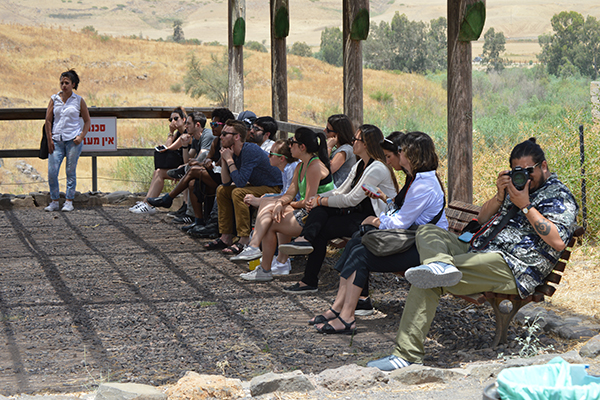
In what organizers hope will be the first in a series of annual reporting trips, 18 students in the international concentration at the CUNY Graduate School of Journalism recently traveled to Israel and the Palestinian territories for a 10-day program uncovering the complexities and challenges of reporting in the region.
The trip was sponsored by the Jerusalem Press Club with funding by the Boston-based Jacobson Family Foundation.
The students were accompanied by Prue Clarke, director of CUNY’s international reporting program, and Andrea Stone, the school’s director of career services.
Participants met members of the Knesset and the Palestinian Authority, activists, settlers, and journalists.
They visited Jerusalem, Mea Shearim, Tel Aviv, Ramallah, Ofra, Shilo, Nazareth, Bethlehem, Be’er Sheva, the Golan Heights, and Metula.
The students, who went on to internships in a dozen countries, will produce a website about the trip that will include video, audio and written reports about different aspects of Israeli and Palestinian society.
A showcase of the students’ stories and experiences is planned at the school for the fall.
Here are some observations from students:
Zachary Williams, interning in Liberia
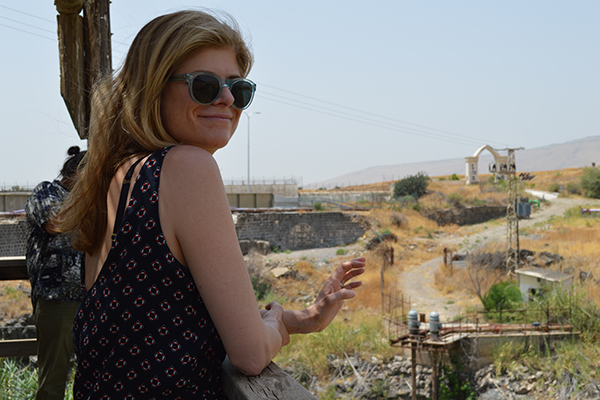
“I awaited that moment of epiphany, when the Israeli-Palestinian conflict would appear in a different light. That happened for me sometime in the Golan Heights. I realized that in the U.S. we see the conflict as a very top-down affair. Jews, Muslims and Christians all want their slice — or more — of the Holy Land. But after hearing our tour guide talk about the issue of water surrounding the Sea of Galilee, I realized that in reality it’s a plethora of small issues that keep peace from happening. Technicalities rather than religious fervor require a thorough and conciliatory approach to any type of settlement. Before CUNY took me on a ride through all of the issues, I would have never seen it quite like that.”
Noah Caldwell Rafferty, interning in Turkey
“The narrative we see in the U.S. media is that Palestinians and Israelis are perpetually at each others’ throats. An eternal standoff, with hands on holsters. To some extent, this was borne out by our experience—we saw, from afar, Hamas-controlled Gaza, Al-Nusra-controlled Syria, and Hezbollah-controlled Lebanon. However, not a single person we met agitated for violence — everyone, from right-wing settlers to a minister of the Palestinian Authority, expressed a desire for peace. This might be a selection bias, considering most of our speakers were arranged ahead of time. But in candid and random conversations with strangers, this desire was confirmed.”
Christina Thornell, interning in Brazil
“I was touched by so many of the people who shared stories with us, but the ones that impacted me the most were the Israeli people who live along borders. Their commitment to their principles at the expense of possible death made me feel a little unsubstantial, though also life-affirming. I was particularly taken aback by a young man who lives on the border with Lebanon and has witnessed rockets landing outside his home. He is unwilling to move his family, including a three-month-old baby, because ‘that is what the enemy wants.’”