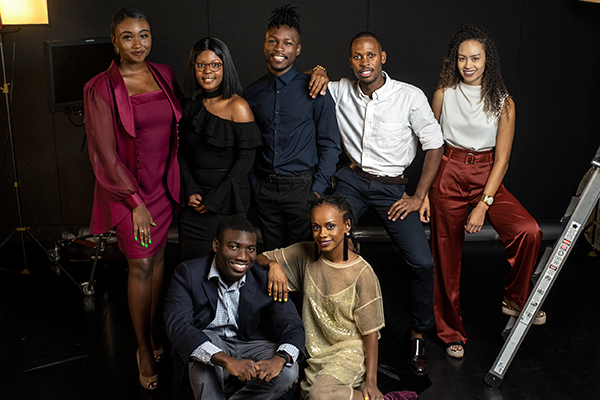
1. IDA B. WELLS SCHOLARS BREAK NEW GROUND
These seven Ida B. Wells Scholars are forging careers in the spirit of the legendary journalist and civil rights activist who battled sexism, racism, and violence throughout her life in the 19th and early 20th century. The Newmark J-School scholars hail from as far as California, Mississippi, and Florida and as close as Brooklyn. They have already produced vital, diverse stories on women of color in venture capital, the connection between sports and business, and the black diaspora in New York.
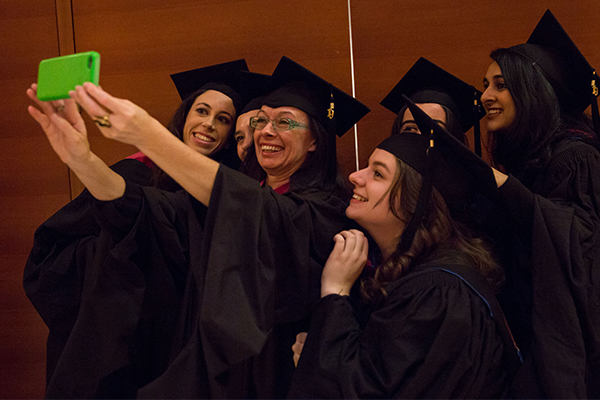
2. AN INSPIRING LAUNCH FOR CLASS OF ’19
One-hundred and eighteen students bounded across the stage at TheTimesCenter at last month’s commencement. They were greeted by Masha Gessen, a New Yorker writer who received an honorary doctorate, as “dear new colleagues.” Gessen also reminded them in their keynote that “journalism is a profession of outsiders. Our job is to go places we don’t belong — and to make sure that we never get comfortable there.”
Alumni speaker Walter Randolph-Smith, ’10, also inspired the students to embrace their outlier roles, and to find jobs “where you can grow, where you can learn and where you can listen. The big job will come but first you have to master the basics. At my first job, a co-worker told me I was too fat, too black and too lispy to make it in the news business. But I am making it, and if a kid from Queens can make it in places like Elmira, Flint, Kalamazoo and Cincinnati, so can you. There are stories everywhere. Chase them, find them, tell them.”
Student speaker Natalia Rodriguez Medina highlighted the school’s diversity, observing: “It makes me so proud to walk into school and not only see a lot of melanin in different degrees, shapes and sizes, but also hear a variety of languages.”

3. HISTORY’S BEST FOR 2020 COVERAGE
Errol Louis and Anna Wintour, the honorees at the school’s Awards for Excellence on May 19, already have shared some of their distinctive expertise, answering a query from this newsletter:
If you could bring back a journalist from history to cover the presidential election in 2020 who would it be and why?
Wintour: It would have to be the late, brilliant mischief-maker Richard Neville, who founded the countercultural magazine Oz in Sydney and London in the ’60s. Richard knew better than anyone how to challenge old, outdated thinking and eloquently celebrate the spirit of youth and change. If he were alive today, he would surely revel in the absurdities of our political moment — he’d lampoon our president for all he’s worth — but he’d also understand the sky-high stakes of this election as well.
Louis: The great columnist H.L. Mencken covered every national political convention from 1904 to 1948, mostly for the Baltimore Sun. He was a hanging judge whose acid pen spared nobody—not the candidates, not the party apparatchiks, and ultimately not even the voters. As a young columnist, I read collections of Mencken’s convention writing for their searing wit. Operating in the days before television, he had a sharp eye for detail, describing the sounds, lighting and setting of the conventions with the practiced eye of a former theater reviewer (which he was). But his real gift was for piercing the pageantry to reveal the underlying power dynamics. In 1940, he sized up the Republican nominee, Wendell Wilkie, and declared him “no more of a wizard than Roosevelt, but he has something of the same capacity to convince idiots that he is.” And he pointed a finger of blame at the American public. “As democracy is perfected, the office represents, more and more closely, the inner soul of the people,” he wrote in 1920. “On some great and glorious day the plain folks of the land will reach their heart’s desire at last, and the White House will be adorned by a downright moron.” A century later, I would love to read his dispatches from the 2020 conventions.
Get Tickets for the Awards for Excellence.
4. ALUMS MAKE NEWS
PRISON LIFE IS HER BEAT
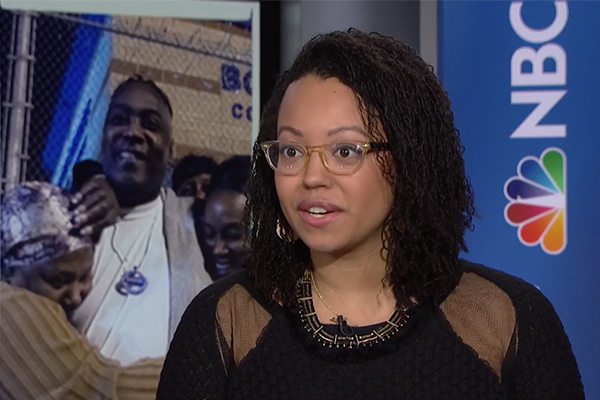
Nicole Lewis, ’16, is starting her third year as a staff writer at The Marshall Project (TMP). Recently, she collaborated with TMP intern Beatrix Lockwood, ’19, on a story for the project about the hidden financial burdens on prisoners and their loved ones. The piece also ran in The New York Times.
Lewis, after graduating from University of Michigan, worked for several years as a community organizer in New York City focusing on inequality and racial justice. She decided journalism school would help deepen her engagement on these topics. She reports now at TMP on issues like prison technologies, including how jailers want to replace inmates’ human contacts with video visitations. She also is working on a first-ever national political survey of the incarcerated, which TMP hopes to roll out before Super Tuesday. In 2016, Lewis won an Education Writers Association award for her contribution to a three-part series on desegregation in Mississippi public schools. “I always had an interest in marginalized groups and work that helps to highlight inequality,” she said. “The kind of accountability journalism that we do at (TMP) is so important.”
TWO NEWMARK J-SCHOOL EXCLUSIVES
Through the school’s exclusive partnerships with top news organizations nationwide, Newmark J-School students and alumni can secure career-enhancing jobs, internships, and fellowships. Shantal Riley, who graduated in December with an M.A. in Journalism, will be a beneficiary this year of one of these special opportunities, joining FRONTLINE as the Tow/Newmark J-School Fellow at PBS’s flagship investigative documentary series. The year-long paid fellowship is funded by The Tow Foundation and is open only to Newmark J-School graduates. Riley will work with FRONTLINE reporters, producers, and developers to contribute reporting across platforms — from its documentary and podcast series to digital transmedia projects. Lakshmi Sivadas, also a ‘19 graduate with an M.A. in Social Journalism, will join The Marshall Project as the Tow Fellow for Audience Engagement. This year-long paid fellowship also is funded by The Tow Foundation and open only to the school’s graduates. Lakshmi will work to deepen the newsroom’s community-engagement, reach new audiences, increase public awareness to support long-term investigations, and expand membership.
5. UPCOMING EVENTS
CAN MEDIA IMPROVE POLITICAL COVERAGE BEFORE THE ’20 CAMPAIGN IS OVER?
Tuesday, Feb. 4, 2020
6:30 PM – 8:30 PM ESTJournalists find themselves critiquing their coverage of elections every four years, concluding after almost every cycle that that their work fell short. Why, they ask, did their reporting focus so much on the horse race and not on what voters really care about? Why weren’t there more stories on the national anxiety about ….? Instead of waiting for a too-late 2020 postmortem, a panel of experts will posit ideas on how the current campaign coverage can be improved. The session will be moderated by Peter Beinart, a contributor to The Atlantic and professor of political science reporting at Newmark J-School. He will be joined by Jamelle Bouie, opinion columnist, The New York Times; Jonah Goldberg, editor-in-chief, The Dispatch; and Clare Malone, senior political writer, FiveThirtyEight. RSVP
FOR GRADUATE JOURNALISM STUDENTS IN NYC, A FREE, CRASH COURSE ON DISINFORMATION
Saturday, Feb. 8, 2020
10:00 AM – 4:00 PM EST
The Newmark J-School will host a free training — open to all graduate journalism students in New York City — on how to identify, verify and report on disinformation in the upcoming election and U.S. Census. First Draft will run the day-long program in the Newmark J-School newsroom. Students will spend the morning working on a simulated crisis, learning to cover breaking news that may occur with online disinformation, such as fake websites, social media posts and manipulated videos. In the afternoon, they will participate in two master classes — in identifying disinformation and verifying online content. The day will close with a group discussion on ethical challenges in covering online communities and the risks and benefits that closed anonymous spaces bring to modern reporting. Pizza will be provided. Students must register with their university email.

PLUS!
To meet the exploding interest in documentary filmmaking, the Newmark J-School launched a new specialization for students to learn all aspects of this important creative form and to complete a single project in the course of their study. In December, Class of ’19 filmmakers presented their final projects, including Woodhouse, a 25-minute work in which Netsanet Negussie, Mankaprr Conteh and Bianca Rosenbert detailed the struggles of an Army captain who built a fashion design career while coping with his parents disapproval of his sexuality; Finding Justice, Hannah Miller’s look at a once imprisoned Samaritan who now helps others overturn unjust criminal sentences; and Women, Natalia Keogan’s scrutiny of how horror films obsess on women’s bodies.
Permalink url: https://us2.admin.mailchimp.com/reports/show?id=1351139